Thursday, July 13, 2006
The Assignment


Tuesday, July 11, 2006
Some Unrelated Thoughts & Responses
There was an interesting response to Steve’s 20 points on excellent library service (from Blog about Libraries) over at The Itinerant Librarian yesterday. Angel takes issue with two of Steve’s points. First, she points out that is difficult not to take extremely bad behavior from patrons personally - and that some behavior is inexcusable. I think that Angel has a point, but sometimes we need to remember that patrons who cause problems are generally in the minority - and the small minority - thank goodness. Despite this fact, we do have policies in place to deal with this type of behavior in order to protect ourselves and have had to bar patrons from using our facilities. Second, Angel disagrees about being flexible with policies. I can see both sides of this issue. Ultimately, I think the best way to handle this is to reevaluate policies often. If you find that you are often being lenient about certain policies, maybe they aren’t really necessary. Maybe fewer policies will help. Of course, I work in a library and I know that we often have to put policies in place so that we can point patrons to them when we have to speak to them about an issue. I would like to point out that this usually happens because students complain (loudly) about other’s behaviors. I admit that we have signs forbidding the use of cell phones - but this is because of the pervasive nature of their use. Students started a campaign to ban the use in the library because they found cell phone use distracting while studying. Ultimately, the library belongs to the students and they have the right to have input into our policies and procedures. Angel sums up her post nicely - “Now, someone will say, “oh, but you are just worried about covering your behind.” You bet I am. Another thing I learned in my years as a educator. Always cover your ass. In the litigious land we live in, not doing it is just foolish. Making some exceptions just opens you to all sorts of vulnerabilities that are better avoided. Why would you do that to yourself, or to your colleagues? So, very nice rules, very true, but take them with a grain of salt, as one should probably take a lot of things in life. And just use some common sense.” I think this is great advice - especially since I try to take everything with a grain of salt.
How to Deal with Schoolwork
Although I haven’t gotten the knack of taking notes on the computer, I have to second Kate’s advice about using introductory and concluding paragraphs, using book reviews to narrow down sources and using RSS feeds and blogs as a source of information. When doing papers or projects, one has to learn how not to read everything. If you can’t scan the introduction to a work and immediately decide if the item is relevant or not, you will waste a great deal of time.
Anyway, it is time for me to get back to work on my paper. I can say that one important part of being able to write a paper without having an attack of hysteria is to actually work on the paper - and not allowing other things to get in the way (like blogging). Thanks for sharing your methods Kate. I appreciate it - and am looking forward to your next installment.
OPAC Resources
- A “Next generation” library catalog - Eric Lease Morgan’s essay in which he outlines a his ideas for the next generation catalog.
Examples of Enhanced Library Catalogs
- Ann Arbor District Library’s Catalog -
- Carroll County Public Library - Using Aquabrowser
- FictionConnection - Bowker’s Aquabrowser interface - username and password required
- King County Library System - Using Aquabrowser
- Lamson Library - Plymouth State University - Casey Bisson’s WordPress OPAC
- North Carolina State University Libraries Online Catalog - The catalog is powered by Endeca’s ProFind with Guided Navigation.
- Penn Library Catalog - The University of Pennsylvania catalog allows users to tag catalog entries.
- University of Huddersfield Library - Addition of “did you mean?” suggestions for failed searches.
Enhanced Services for the Library Catalog
- Aquabrowser
- Drupal - A content management system used by Ann Arbor District Library.
- Endeca
- LibraryElf
- RedLightGreen
ILS Vendors
- Endeavor Information Systems - Voyager
- Ex Libris - Aleph 500, SFX, Metalib, DigiTool, Verde, primo
- Extensity - VubisSmart
- Innovative Interfaces, Inc. - Millennium
- SirsiDynix - Unicorn, Corinthian
- VTLS - Viruta
- Full listing - From Library Technolog Guide edited by Marshall Breeding
Sunday, July 09, 2006
Some Reflections and a Surprise
I have only been taking classes for about 10 months - and am currently taking my 4th class (out of 12). The learning process has been wonderful - and it has certainly stimulated my mind. Even though, I am often studying subjects that I am very familiar with, I have been able to think about these subjects in new and different ways. I’m much more engaged while I am at work - and thinking about the library from the patron perspective. So, school has done what I had hoped it would do for me. However, one thing that has been so unexpected has been the effect of blogging on this entire process. As I have mentioned before, I started this blog as a way to document my process through school. Because I am taking classes online, I think it is important to have a online way to document the experience. I also thought that actually creating a blog would be the best way to learn about them, understand them and discover how they could be useful in a library setting. I honestly did not expect to get much out of the process. Surprisingly, I have to admit that blogging has been a wonderful experience that I am enjoying for more than I would have thought. Additionally, it gets me thinking much more creatively about my work than I would have thought possible. Who would’ve thought?
Thursday, July 06, 2006
Scholarly Value of Blogs
My comments on Jane’s post:
“Over the past several months, I have been amazed (and often overwhelmed) by the sheer amount of information available about libraries via blogs. I see the library blog world as such a rich community filled with passionate people who care deeply about their profession - and who are interested in affecting revolutionary change in the library sphere. I am extremely interested in the impact of blogs on communication - formal and informal - and am mulling over ideas about examining the world of library blogs for my special project/master’s thesis (which is still a while in the future). I also still value the information garnered by traditional research methodologies, but I think it is time to look at the world of blogs in a more scholarly manner. I find the discussions that are currently taking place about the OPAC (as one example - at this point it happens to relate to a specific class that I am taking) to be extremely significant, thought provoking and worthy of review in a scholarly manner. How it will all pan out is a different story, but I think it is worth the investigation (supported by traditional literature reviews and research).
By the way, the majority of my current reading in terms of professional development and awareness is also done through blogs, web sites, etc. Generally, any new developments that are worth noting have been mentioned in someone’s blog - with a link to more in depth information. I think it would be extremely interesting to look at the ways in which blogs have influenced professional development.”
PS. Is anyone else annoyed by the fact the spell check in blog software always identifies the word blog as misspelled????
Excellence in Customer Service
And by the way, I don’t think that these lessons are just important to libraries - especially points #4 Follow the Golden Rule, always and #9 Be professional; take customer service seriously (I think they are just as important in our day-to-day lives). Customer service is almost non-existent in today’s society. Our society has an alarming tendency to blame the customer for problems. Everyone could use a bit of help to remember the value of good customer service. I’d like to show this post to people at my bank, my mortgage company and I would especially like to show this to people who work in retail stores. It doesn’t have to be difficult - something as simple as saying “Please” and “Thank You” can make people happier.
Wednesday, July 05, 2006
OPAC Blog Posts - A List
July 11, 2206 - I am no longer updating this list of OPAC Blog posts on this site. For the most recent version of this post, please visit the OPAC Blog Posts - A List via WordPress. It has become too difficult to update the list in both places.
The latest assignment for my summer class is a 10-15 page paper about one cataloging related subject that we choose from a list of 15 suggested topics (due on July 17th). Although I haven’t made my final choice about the theme of the paper, many of the suggestions on the professor’s list deal with the automated library catalog and the user’s experience of searching. I’m interested in using some of the recent blog discussions about the OPAC/library catalog/ILS as part of my paper. As such, I’ve started putting together a list of relevant blog posts. This list is a work in progress. I intend to update the list - and start annotating it as part of my research.
LibrarianInBlack
- Karen and the Sucky OPAC - The LibrarianInBlack comments on Karen Schneider’s “How OPACs Suck, Part 1: Relevance Rank (Or the Lack of It),” The LIB comments that ” This relevancy ranking issue is one of those changes I’d like to see happen. I agree with Karen that this is something that librarians should be demanding…not simply wishing for.”
- Library website goals - The LIB agrees about the importance of single sign on (which isn’t something that we are even close to at my small library either!!) and references John Blyberg’s post Library 2.0 websites: Where to begin?
Family Man Librarian
- Library online catalogs and relevancy ranking[updated] - A post in which the Family Man Librarian disagrees with Karen Schneiders’ post How OPACs Suck, Part 1: Relevance Rank (Or the Lack of It). The FML takes issue with Karen’s points that most online catalogs don’t have relevance ranking and that ILS vendors are wholly to blame for this lack of relevance ranking. FML contends that we need to “look at both sides of the issue and especially do not be so quick to lay blame without truly understanding the reality of what vendors provide and what they do.”
Blyberg.net
- 2006: the year of the phoenix OPAC? - In this post, John Blyberg points to several significant developments in OPACs: NCSU’s new online catalog, Casey Bisson’s WordPress OPAC project, Ed Vielmetti’s third-party library apps with RSS feeds and Dave Pattern’s work with a new patron-oriented presentation layer to the OPAC. Blyberg’s own experiences also lead him to conclude that the public is “hungry” for social additives to the catalog. Blyberg writes that 2006 “is shaping up to be the year a new OPAC vision is created.”
- ILS Customer Bill of Rights - John Blyberg details “four simple, but fundamental” needs from ILS vendors: 1) Open, read-only, direct access to the database, 2)A full-blown, W3C standards-based API to all read-write functions, 3)The option to run the ILS on hardware of our choice, on servers that we administer and 4) High security standards.
- Library 2.0 websites: Where to begin? - John suggests five directives to help redesign library web sites: social software, open-source software, single sign-on, open standards and an integrated OPAC.
- Why bother: the impact of social OPACs - Blyberg makes is clear that he does not “think we are doomed if we choose not to implement social software in our OPAC.” He contends that by adding social software and/or applications we can create a feeling of community within our OPACs. One key point is that “findability is not the goal, but the activity and the experience which is why I say that OPACs have the potential to be fascinating places to visit and browse.”
- OPACs in the frying pan, Vendors in the fires - A round up of blog posts about OPACs, ILS and vendors for early June 2006.
A Wandering Eyre
- Actual Reasons Why My OPAC Sucks - Jane offers 16 actual reasons why her OPAC sucks in response to an actual comment.
- OPACS (everyone together now) SUCK - Jane reflects about the the concepts of tracking and finding in relation to the OPAC and about how they are different. She suggests that these two concepts intersect at the point where we need to locate an item at a specific moment in time and that this is a good starting point for the conversation about how to make things easier to find.
- We Are Broken, Not Them - A response to Karen Schneider’s post THE USER IS NOT BROKEN: A MEME MASQUERDING AS A MANIFESTO in which Jane adds several of her own points to Karen’s.
ALA TechSource
- From Swine to Divine: NCSU Unveils New Online Catalog - by Teresa Koltzenburg
- The Revolution Will be Folksonomied - by Karen G. Schneider
- Measuring My First CIL - by Tom Peters
- How OPACs Suck, Part 1: Relevance Rank (Or the Lack of It) - by Karen G. Schneider
- How OPACs Suck, Part 2: The Checklist of Shame - by Karen G. Schneider
- How OPACs Suck, Part 3: The Big Picture - by Karen G. Scheider
Maison Bisson
- …And Then You Realize You Wasted Your Life
- Raging Arguments About The Future of the ILS
- Presentation: Designing an OPAC for Web 2.0
- WPopac: An OPAC 2.0 Testbed
- WPopac Gets Googled
- Free Markets, Bad Products, Slow Change Rates
Library Garden
Disruptive Library Technology Jester
- Is the Writing on the Wall for the Integrated Library System?
- “Is the Writing on the Wall?” - Take 2
Lis.dom
What I Learned Today
Librarian.net
Science Library Pad
- dear OPAC: change or die
- full text is coming . . . OPAC is going?
- academic libraries dislocated by technology
Confessions of a Science Librarian
ex libris
Swem Review of Technology
- The Catalog Under Scrutiny – Part 1, a look at the OPAC
- The Catalog Under Scrutiny - Part 2, Open Source and the ILS
Librarian 1.5
ebyblog
- Goal Based Information Retrieval Experiences
- The Flexible OPAC
- Plenty of Suckage to Go Around
- This Old Library
- Spamming Google with the OPAC
Library Laws are meant to be broken
Participation Literacy
LawLibTech
Crossed Wires
- What Web Users Hate Part 1: Search and Browse
- What Web Users Hate Part 2: Scanning the Site
- What Web Users Hate Part 3: Reading
Library clips
Librarian in the Middle
The Goblin in the Library
Panlibus
ACRLog
Free Range Librarian
Information Wants to Be Free
- Casey Bisson Speaks! We should all listen.
- Dumb down the catalog? Yes, lets!
- The Failure of Middleware, Part 1: What’s the problem?
- The Failure of Middleware, Part 2: Who are our users?
- The Failure of Middleware, Part 3: How do we measure up?
- The Failure of Middleware, Part 4: What Works?
- The Failure of Middleware, Part 5: The Unintegrated Library System & Federated Search
- The Failure of Middleware, Part 6: Link Resolvers
- The Failure of Middleware, Part 7: OAI and Google Scholar
Affording the Rock-N-Roll Lifestyle
Catalogablog
OPAChyderm
LibDev
Lorcan Dempsey’s weblog
- Lifting out the catalog discovery experience
- Thinking about the catalog
- A service-able catalogue
- Discover, locate, … vertical and horizontal integration
LibraryCrunch
Walt at random
TechEssence.Info
- Forcing Users to Learn the Catalog - by Thomas Dowling
- Rethink the role of the library catalog - by Eric Lease Morgan
Pegasus Librarian
- Empathy, But Not Sympathy for Innovative
- Changing Nature of the Catalog
- Search Motivation and the Expert/Novice
One Big Library
My posts
- The OPAC Strikes Back
- Additional Thoughts on the OPAC
- The OPAC Debate Continues . . .
- Are We Really Ready to Say Goodbye to the Sucky OPAC?
- The Main Reason I Think OPACs are a Problem
- The Motivation Behind the Search
- The User Isn’t Broken - But Neither is the Library
- Library Users & the Catalog
Updates:7/6/2006 - I added some additional blog posts to the list and started to annotate the entries.7/7/2006 - I continued annotating some entries. I changed the formatting of the post to (I hope) make the post easier to read (using bold for blog names and bullets for posts).
Monday, July 03, 2006
The OPAC Strikes Back
any decent OPAC is also good for something other than known item searching that matters to quite a few library users: "What do you have by this author/composer/musical group?”
Regardless of whether you put this type of question in the known search category or not, I think that Walt is making an important point about the OPAC in his post. The OPAC is the interface to the physical collection of the library. I agree wholeheartedly that there are some serious issues with searching - especially via subject. And I also agree that we need to seriously overhaul how we do business in the library. Yet despite this, I do not believe that the OPAC is the root of all evil. It serves a very important purpose in the library. Does is work best for staff who understand how to search it and how to find information? No question that it does. Learning to search the library catalog is often too much work for many library patrons. Yet, I do not believe that we should be chucking our systems out the window - because 1)we need the OPAC - especially from the library staff perspective 2)we have nothing good to replace it with despite all of the recent conversations about nexgen catalogs and 3)it is a quick way to find out if a specific item is available - whether one is searching for a known item or to unknown items by an author/composer/musical group (and I would add actor/director).
Ultimately, in any redesign or rebuilding of the catalog, we need to make sure that we preserve the ease of discovering known items - including the discovery of the “what do you have by this author/composer/musical group/actor/director?” In my opinion, we have learned a great deal about what works and also about what does not work for our patrons. But, we have a decent basis upon which we can build a better interface - whatever form that interface takes.
Wednesday, June 28, 2006
A Night Off
Monday, June 26, 2006
To Get Personal or Not?
However, I have to say that some of my favorite blogs have a great deal of personal information that makes one feel as if they are getting a glimpse of the person behind the written word. Much of this introspection was prompted by a really nice post by Mark Lindner at . . .the thoughts are broken . . . who lets a great deal of himself shine through in his blog. I really identified with his comment that “This whole web thing is so very odd.” It seems very odd that one can create a web presence and people actually do read it. Much like Mark, I spend time looking at feed stats and web stats and often wonder about those who read my blog. Given that I initially created this blog as a way to document my progress through graduate school with content in which only I would be interested - and possibly my professors or advisors since I plan to use this as the base for my eportfolio - I am often amazed that there are people who do visit the site. I generally don’t obsess about it - but mostly because I don’t let myself think about it. But again, “This whole web thing is so very odd.”
Anyway, Mark (since you asked), I find your blog very fascinating and enjoyable. You often have a different perspective on topics than I do, but I am a firm believer that this is how we learn, expand our own knowledge base and gain the confidence to form our own beliefs. I don’t often read your posts about the music you are listening to or the movies you have seen, but have come to understand that these are important parts of your life. Don’t change a thing!
The other post of a personal nature that I really enjoyed is Meredith Farkas’ post You may not be the person you think you are from Information Wants to Be Free. The past couple of years have been (probably just the start) of a journey of self discovery for me. Returning to school has been part of this whole process where I have been trying to challenge the “safe boundaries” that I have set for myself throughout the years. Meredith put it better by asking what if you aren’t the person you think you are. While my story is of course different than Meredith’s (I have always been very happy with the person I am), I took comfort in her story. Despite being happy with the person I am, life throws curve balls at incovenient times that can make one doubt one’s selve. So, we have to throw some of our own curve balls back at life - and I think that trying to look at ourselves in different lights may be part of this. Thanks Meredith!!!!!
Ultimately, these two posts made me realize that the addition of personal information helps to add tremendously to one’s blog. Without a doubt, my favorite blogs contain a great deal of personal reflection. I also think the personal reflections are an important part of my journey through graduate school - and through life. Sometime, I will share the story of why my biggest fear in life is blue toilet paper (yes, it really is!).
First Assignment Completed
At this point, I am thrilled that I am done - and trying to not worry too much about the grade (which is 25% of the overall grade). There isn’t anything I can do about it now. I definitely need some space from AACR2, MARC tags and all of the rest of this cataloging stuff!!!
Thursday, June 22, 2006
Homework is Going Well
Wednesday, June 21, 2006
Fun with MARC Fields
So, I think that spending some time on this each day will be essential to keep up. The good thing is that much of the work is cumulative. Each week, we catalog several new documents - and that helps keep the earlier stuff fresh in my head. Anyway, I feel much better about this class than I did even a week ago. Repetition is key to much of these principles and rules. I will admit that reading and interpreting AACR2 is no fun!!! On to main and added entries . . .
Tuesday, June 20, 2006
Back to School Work
So, I resolve to :
- dedicate my entire evening doing homework - committing AACR2 rules to memory (ok, that may not happen)
- dedicate some time every day to working on homework
- get cracking on my cataloging assignment that is due on June 26th
- end my blogging addiction. Fortunately, help is available.
Monday, June 19, 2006
Additional Thoughts on the OPAC
So ultimately, we aren't just looking at ways to improve our OPAC. I think we are looking to improve our libraries and our way of business. Most of our policies and procedures were developed before the internet, before the advent of full-text resources, etc. Maybe we should be starting by looking at our mission statements, reexaming our services, question everything, think about all aspects of our day-to-day business. Only when we truly understand ourselves can we even begin to try and understand our patrons. Hopefully, if we do it right, we will be better able to deal with future changes in a more timely manner.
The OPAC Debate Continues. . .
As for OPACs, John's summation of Peter Murray's Is the Writing on the Wall for the Integrated Library System? got me thinking about several things. Like John, I agree with Peter that the "ILS/OPAC" is an an asset management system tool - one which the library needs in order to operate. I would also agree that OPACs do get used - and add that this is the case in academic libraries as well. Students do tend to gravitate towards database aggregators to find full-text articles first, but they do use OPACs to search for materials with remarkable frequency (remarkable given that recent debates often give the impression that OPACs are unusable). In the library where I work, we could not survive without our OPAC (sucky or not). This does make the OPAC a useful tool as an interface into our ILS. It may not be the best interface and it may not even be the right solution to meet the needs of our users, but right now it is really the only window into the ILS that we have.
Additionally, this post really made me think about the tendency to lump our criticisms of ILSs and OPACs into one bundle. I wonder if this is a mistake. The user doesn't care one bit about our ILS and what it does (or doesn't do). It cares about the interface and the ease of finding information. Users don't want to restrict their search to just our asset management system. As such, I think it would be helpful to separate the two discussions. What we want from our ILS vendor or open-source systems is very different from what our users want/need in our interface into that system. I also think that by lumping the ILS/OPAC together, people tend to focus on the problems with the OPAC rather than on the back end of the interface. To build a better system, I really believe that we need to think of these two entities independently - because they both need revamping. Determine what the user needs. Determine what the library needs. Then, make sure your ILS the information required by both. Anyway, it helps me tremendously to think of the ILS and the OPAC as separate entities.
I do also like John's take on my post Are We Really Ready to Say Goodbye to the Sucky OPAC? From my perspective in a small academic library, we are only just starting to develop the "vision, passion, and courage" that is necessary for change. Right now, I feel like the most important thing that I can do is to help get those I work with to develop a vision, a plan and a purpose. I've said before that without buy in from those with whom we work, we would only be imposing change - which I can only see as hurting the end user. Meanwhile, we work on small change within our current infrastructure - and this is the best thing that we can do for our users at the moment. Some have suggested that spending time on broken systems may be a waste. However, I can't agree. Current OPACs can be made more usable. And I think this is also an important step in this whole process. If nothing else, it helps us define and refine the user experience.
Thursday, June 15, 2006
What Doesn’t Work So Well Online
This is in no way a criticism of my current class. The professor has provided detailed answers to the exercises and notes based on discussion questions raised by students. I think he is doing a great job so far. This is just an observation - and is the first time I have missed the face-to-face interaction. I really need to sit down and spend much more time doing the exercises. I think that repetition will be the key to getting some of this stuff down pat. And, yes, I so badly want to look at official cataloging records in OCLC - but I will persevere in order to learn this stuff!!!
Wednesday, June 14, 2006
Academic library 2.0 concept model
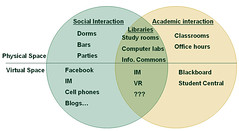
Wow! I love this model. I think it is right on - and a great way to envision the role of the library. I guess I've never really thought about libraries sitting physically between the social and academic parts of the student experience in college. It seems like such a simple concept - yet not one that everyone grasps. I think many academic libraries identify solely with the academic part of the college experience - and this might account for some of the hesitation in adopting social software. Often if something doesn't support the academic mission of the college, it gets vetoed. However, it would be difficult to argue that libraries are not social spaces - just social spaces in which academic endeavors take place. Michael Habib argues that libraries have traditionally straddled the social and physical parts of a student's life. With some thought, I agree - but I'm not sure many library people think about libraries in this light. A big thanks to Michael Habib for posting this.
Image from habibmi - Flckr
Michael Habib's blog entry - Conceptual model for Academic Library 2.0
Are We Really Ready to Say Goodbye to the Sucky OPAC?
While I know that there is a whole group of library bloggers who would shout YES to this question, I really can't imagine that most libraries would be able to ditch their OPAC in the immediate future. Most of us are not at this point. First of all, there isn't enough buy in from library staff. And this is a big point. As much as forcing change on users is not a good idea, it isn't any better to force it on library staff. Second of all, major changes require planning (many people have commented about the pace of change in libraries) be it for budgetary support, technological support or just for good implementation. And at this point, there isn't a good consensus about what it is that we need in place of the OPAC. There is no system in place from which we at smaller institutions can use to build upon. Third, the amount of money we have invested in our current library system means it isn't going anywhere soon. Regardless of whether this should be the case, it is.
So, this is why I think it is important to spend time tweaking our current systems to make them more usable. Just because the system is sucky doesn't mean that we should just accept it until we come up with something better. I think just giving up on our current systems would do a disservice to our users.
Ultimately, for those who think we need to chuck our sucky OPACs out the door and move on, I would be incredibly interested to hear their views on what would replace it. What is the vision? How does it work? How do we implement it? Do we even know what it should be? (I know I don't know enough about the users needs and search habits at my library to think I have a handle on this.) I'm obviously still formulating my thoughts on this issue - and haven't gotten far beyond the realization that our current systems are not cutting it.
Update to Post - 6/15/06
**Jane's comments were posted to my wordpress blog - additional comments on A Wandering Eyre